
Special Ad Category, explained for finance advertisers
If you advertise loans, credit, or financial services on Meta, you’re in a Special Ad Category. Here’s what it changes and how to work inside it without fighting it.
If you run ads for loans, credit, insurance, or financial services on Meta, you’re almost certainly in a Special Ad Category, whether you set it up that way or not. The financial products net is wide, and it catches more than lenders: insurance, debt services, credit building, and banking offers all land inside it. Getting this wrong is one of the most common reasons accounts get flagged, so it’s worth understanding what it actually changes.
What it changes
Two things, mainly.
First, you lose a lot of targeting. On the specifics: age collapses to 18 and up with no upper bound you can set, gender options disappear, location loosens from zip codes to a broad radius, and most of detailed targeting plus lookalike-style audiences go with them. What survives is broad delivery, your creative, and your offer.
Second, your copy and creative are held to a stricter standard, especially anything that implies a personal attribute of the viewer or promises a specific outcome. This is the part people underestimate: the classifier reads the text on your images and your landing page, not just your primary text, and it’s pattern-matching for language that speaks to who the viewer is rather than what the product does.
The targeting restriction sounds like a downside, and advertisers hate it at first. But it pushes you toward broad, creative-led campaigns, which is where Meta wants everyone anyway. The accounts that struggle in this category are usually the ones still trying to micro-target their way around it.
Work with it, not against it
I’ve watched people burn months fighting Special Ad Category, trying to recreate the targeting they lost. It doesn’t work, and it invites scrutiny. The accounts that win lean into broad targeting and put their energy into creative and offer instead.
In a category where you cannot out-target anyone, the creative is the lever.
The cadence that replaces targeting
Since testing volume is the strategy, I run a default cadence of 6-2-2-2: six images in two sizes each, two videos, two angles, two ad sets. The angles are the part that earns the money. Two genuinely different arguments for the same offer teach you what the market actually responds to. Six variations of one argument mostly teach you which shade of blue photographs well.
What retires a creative is the account’s real cost per result against its own baseline. Not clicks, not comments, and not anyone’s taste, including mine.
What good broad looks like
Consolidated. Few campaigns, few ad sets, budget concentrated enough that each ad set can actually exit the learning phase instead of starving in a fragment. My health check scores account structure exactly this way, because in these verticals consolidated-and-broad beats fragmented-and-clever over any stretch of time worth measuring.
Targeting still happens. It just happens inside the creative: a hook written about consolidating balances finds the person thinking about their balances without a single interest box checked. That’s what "the creative is the lever" means in practice.
The setup that keeps you safe
Set the category correctly in Ads Manager. Keep the landing page aligned with the ad. Keep required disclosures where they belong. Write to the process, not the person.
The declaration deserves its own sentence, because people treat it as optional. Meta’s classifier looks at what you’re advertising, not at what you declared. Run a loan ad without the category set and the likely sequence is rejections first, then account-level attention if you keep doing it. The declaration costs you targeting options. Skipping it risks the account itself, and in this vertical that isn’t a trade, it’s a giveaway.
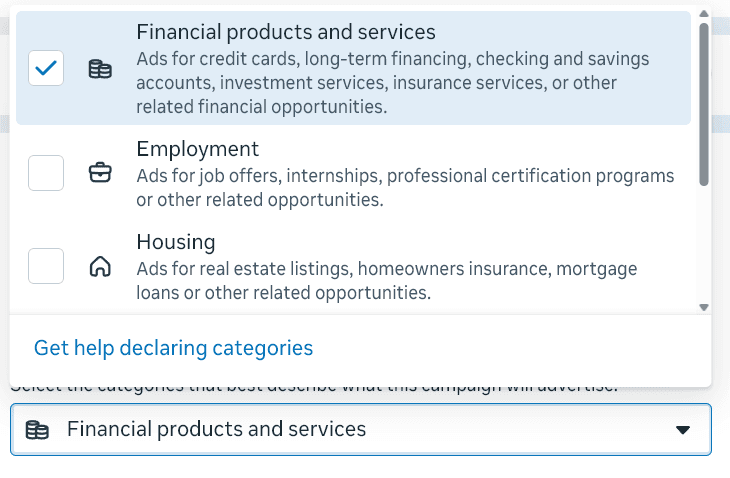
None of it is complicated, but all of it matters, because in this category the account is the asset and you don’t get many second chances.
The moat nobody wants
Advertisers who grew up on micro-targeting read all of this as a handicap. I read it as a moat. Most agencies never learned to run broad well because nothing ever forced them to, and when the rest of Meta drifted toward broad anyway, the finance advertisers who’d been forced there years earlier were already fluent. The skills this category demands are the ones that scale everywhere else too: clean signal, creative volume, and offers that carry their own targeting.
Roughly 90% of my work lives inside these constraints. That’s not a limitation I put up with. It is the specialty.
If you want to confirm your account is set up cleanly for a Special Ad Category, the free Meta Ads health check covers compliance along with the rest of your setup.
Common questions
Do I have to use Special Ad Category?+
If your ads promote credit, loans, or financial products or services in the US, Meta requires the Financial Products and Services category. Setting it correctly is not optional, and getting it wrong is a common cause of flags.
Does Special Ad Category make ads perform worse?+
It removes some targeting options, so the account leans on broad audiences and creative. With clean tracking and strong creative, that setup performs very well. The constraint is the specialty, not the handicap.

Written by Keith Guirao, founder of Maven Media. Media buying since 2012, specialized in Meta since 2017. More about Keith →